Average New Car Transaction Prices Hit an All Time High at nearly $50,000
Valerie Raskovic
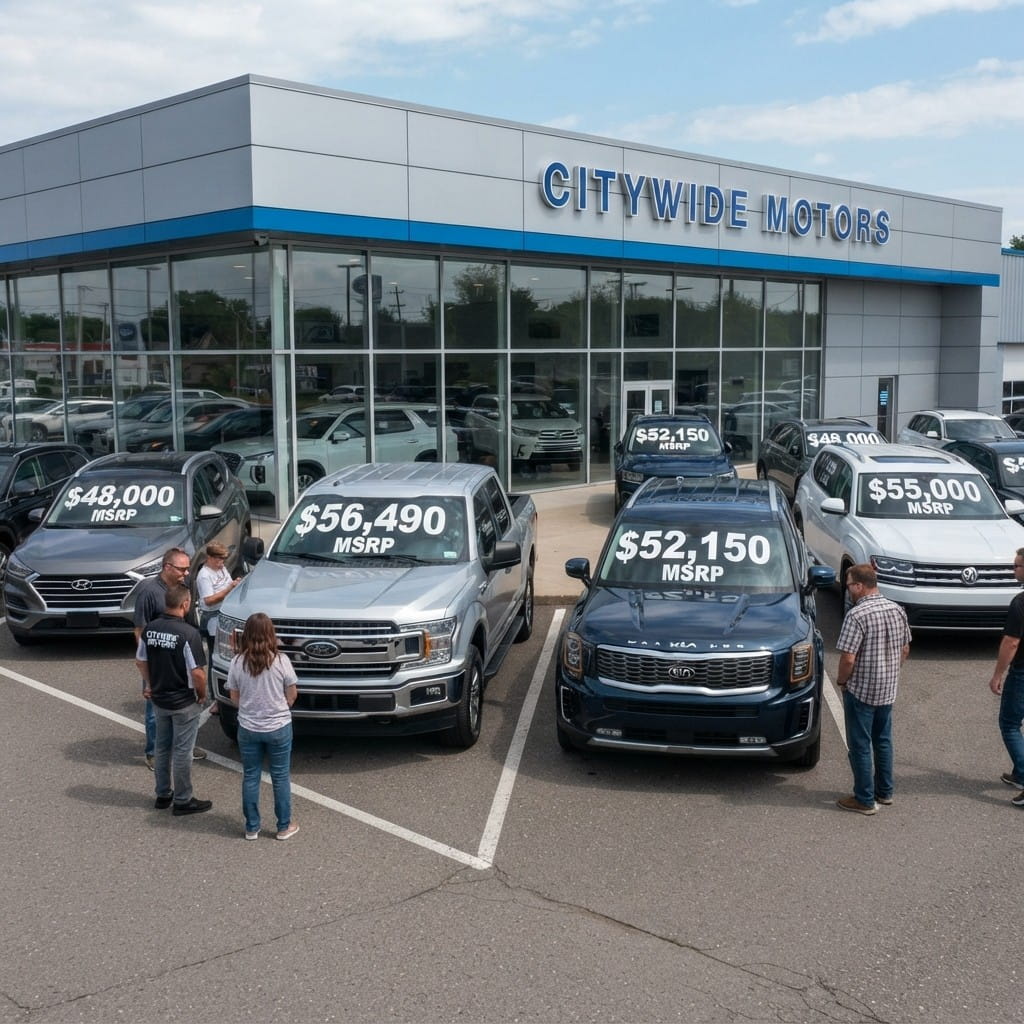
The definition and perception surrounding the “average” new-car price have changed drastically over the past several years. The latest Kelley Blue Book data illustrates the growing affordability crisis. In July 2026, the average transaction price for a new vehicle climbed to $49,855, the highest level of the year and roughly an 11-month high, putting the average new vehicle within striking distance of the $50,000 mark once again.
The increase is especially notable because consumers are already burdened by higher prices across practically all aspects of everyday life and have been shifting towards less expensive vehicles within the last couple of years. Buyers have been moving away from some of the most expensive segments and towards smaller SUVs and other entry-level models, yet the industry-wide average remains extraordinarily high. In June, for example, the average transaction price was $49,758, meaning July brought another increase even as affordability continued to influence purchasing decisions.
Reasons for price increase
One of the biggest reasons today's new vehicles cost so much is simply the cumulative effect of inflation. The dollar got weaker as regular consumer goods climbed in price. Even with the latest news of inflation slowing, prices will not return to where they were just a few years earlier. Just like all businesses, car manufacturers are coping with an ever-changing landscape both in market demand and rising production costs. Automakers are constantly calculating labor, transportation, energy, materials, interest rates and manufacturing costs in order to determine product costs and allocation.
This affects new car buyers two-fold. Consumers are affected by the out-the-door vehicle price as well as the interest rate, which is considerably higher than in the previous years.
The broader inflation picture has also been complicated by geopolitical events. The ongoing U.S.-Iran conflict has disrupted energy markets and significantly contributed to higher oil and gasoline prices. U.S. gasoline prices were averaging more than $4 per gallon in August, while oil prices have remained substantially higher than a year earlier amid concerns surrounding supply disruptions and the Strait of Hormuz.
Higher energy prices have a great impact on consumer behavior, while larger vehicles like trucks and family SUVs are preferred in a time when energy costs are low, more economical vehicles such as hybrids and EVs are in demand during times when fuel costs are high. High energy costs also have a huge impact on manufacturing as suppliers face higher operating costs. Those expenses can ultimately find their way to consumers in forms of higher new car prices.
Another issue affecting new car prices is global instability. The automotive industry is particularly vulnerable to global instability because modern vehicles depend on an enormous international supply chain. Just because a vehicle is assembled in the United States, it does not mean it is fully manufactured here. Even cars that are mostly assembled in the homeland contain components and raw materials originating from dozens of countries. Semiconductor manufacturing, metals, batteries, plastics, electronics and other components are all influenced by international trade and geopolitical conditions.
The continuing conflict involving the United States and Iran has added a very serious source of uncertainty not only for car companies but also for consumers. While consumers may choose to postpone large purchases or be more frugal when embarking on their car purchase journey, automakers are presented by a complex set of challenges. Uncertainty in the markets makes it more difficult for car manufacturers to predict costs. Rather than absorbing every increase themselves, manufacturers can eventually pass some of those costs on to consumers through higher vehicle prices, reduced incentives or both.
Another important piece of the puzzle is financing. Despite historically expensive vehicles and relatively high interest rates, lenders have become more willing to extend credit. Cox Automotive's Dealertrack Credit Availability Index reached 104.6 in June 2026, its highest level in more than a decade. The increase was driven largely by purposely increasing approval rates and a greater share of longer-term loans.
While financial institutions have some guards in place to help safeguard banks and investors, it is not unrealistic to say that the market is highly volatile and an influx of high-risk loans is likely to cause lasting damage. Flooding the market with subprime loans has proven to have had a devastating effect in the past. The industry-wide auto loan approval rate reached approximately 73.8%, 1.5 percentage points higher than a year earlier.
While cars are becoming easier to buy and finance, it does not make the cars cheaper; in fact, it has quite the opposite effect. The Federal Reserve Bank of New York also reported that consumers took out a record $211 billion in auto loans during the second quarter of 2026. The average amount financed for a new vehicle reached $43,925, while the average monthly payment increased to $770. Experian reported that more than 35% of new-vehicle loans in Q1 2026 had terms longer than six years, compared with about 31% a year earlier. While longer loan terms are also helping make large purchases appear more manageable monthly, it does increase volatility. It allows more consumers to purchase vehicles that they might otherwise be unable to afford a new car. As history has taught us stretching the dollar in such as way is generally a bad idea that leads to ramped defaults.
Since when did paying $50,000 for an average Vehicle Become Normal?
Perhaps the most significant change brought on by market changes and inflation is a psychological one. In the past, a $50,000 new vehicle represented an opulent purchase within the luxury car segment and it was mainly reserved for the well-to-do segment of the country’s population. Today, that number is approaching the industry average.
Kelley Blue Book's data shows that the average transaction price briefly exceeded $50,000 in late 2025, reaching $50,609 in December. July's $49,855 average shows that the market remains very close to that threshold. This does not mean every new vehicle costs $50,000. There are still affordable cars and smaller SUVs available for considerably less. But the industry's sales-weighted average is influenced by what Americans are actually buying. The $50,000 average figure is calculated based on all cars, trucks and SUVs sold in the country. While the price is inflated with sales from larger, more expensive vehicles, the truth of the matter is gone are the days when you can buy a regular family vehicle under $30,000. The fact of the matter is that almost 92% sold in the U.S. today cost more than $30,000. In fact, even finding a car under that price point can now be somewhat of a challenging endeavor.
Incentives Aren't Enough to Reverse the Trend
Automakers have attempted to offset higher prices through discounts and incentives, but those incentives have not been enough to bring the overall market back to pre-pandemic pricing. The truth of the matter is that inflation cannot be reversed with even the most aggressive incentives.
In fact, EV incentives have recently fallen significantly, while the average transaction price for a new EV reached $56,126 in July, up 1.6% from a year earlier. Reduced discounts and tighter inventory have given manufacturers more pricing power in some segments. This creates an unusual situation in which consumers are being offered financing and incentives to encourage purchases while simultaneously facing much higher underlying vehicle prices. This results in a market where the monthly payment can become more important than the actual purchase price.
The Hidden Cost of a $50,000 Average Vehicle Pricing
The affordability crisis does not just revolve around the vehicle’s purchase price. The bigger concern is what happens when that price is financed. A buyer who finances tens of thousands of dollars for six or seven years can end up paying substantially more than the sticker or transaction price after interest. Longer loan terms reduce the required monthly payment, but they also extend the period during which the buyer owes money on a depreciating asset. As the end of the loan term comes the consumer can pay as much as 30% more for the car than its original purchase price.
Consequently, more consumers that buy into long-term financing are going to be hit with a real dilemma of becoming upside down on their loan. Negative equity commonly occurs when the car owner owes more on the vehicle than it’s worth. In fact, J.D. Power reported that 29.4% of trade-ins in July had negative equity, meaning those vehicles were worth less than the amount remaining on their loans.
This can create a snowball effect in which consumers trade in an existing vehicle, roll the remaining loan balance into a new loan and start the process again with an even larger amount financed. This could lead to serious financial burden.
What This Means for Car Buyers
While car dealers and manufacturers may say otherwise, the truth of the matter is that affordability cannot be measured by the monthly payment alone. A $700 or $800 monthly payment may seem manageable compared with a household's income, but the buyer should also consider the total amount financed, interest paid, loan term, depreciation, insurance, maintenance and fuel costs.
With new-vehicle transaction prices hovering around $50,000, consumers have more reason than ever to research a vehicle before buying. Comparing multiple models, obtaining financing offers from different lenders and checking the vehicle's history and market value can help prevent an expensive purchase from becoming an even more expensive mistake.
For buyers who don't need a new vehicle immediately, keeping an existing vehicle running may also make financial sense. The average age of vehicles on American roads continues to rise, and repairing an older vehicle can sometimes be substantially less expensive than replacing it with a vehicle carrying a $50,000 price tag.
The New Reality
The nearly $50,000 average transaction price is the product of several forces working together: years of inflation, higher manufacturing and transportation costs, global instability, energy-price volatility, changing consumer preferences, expensive vehicle configurations and increasingly accessible automotive financing.
The fact that lenders are approving more loans is helping sustain demand even while affordability deteriorates. Record levels of auto borrowing and longer loan terms allow consumers to continue purchasing expensive vehicles. However, they also increase the amount of debt attached to those purchases, thus further exacerbating market volatility.
Rising car prices is just one aspect of today’s life that is affecting the American consumer. Higher food prices, energy costs, medical costs continue to decimate the middle class and create extreme income inequality. It is uncertain how long consumers can continue absorbing higher prices and larger loans before affordability begins to meaningfully change what Americans are willing or able to buy.
Read more articles