How Often Should You Change Your Car’s Transmission Fluid?
Valerie Raskovic
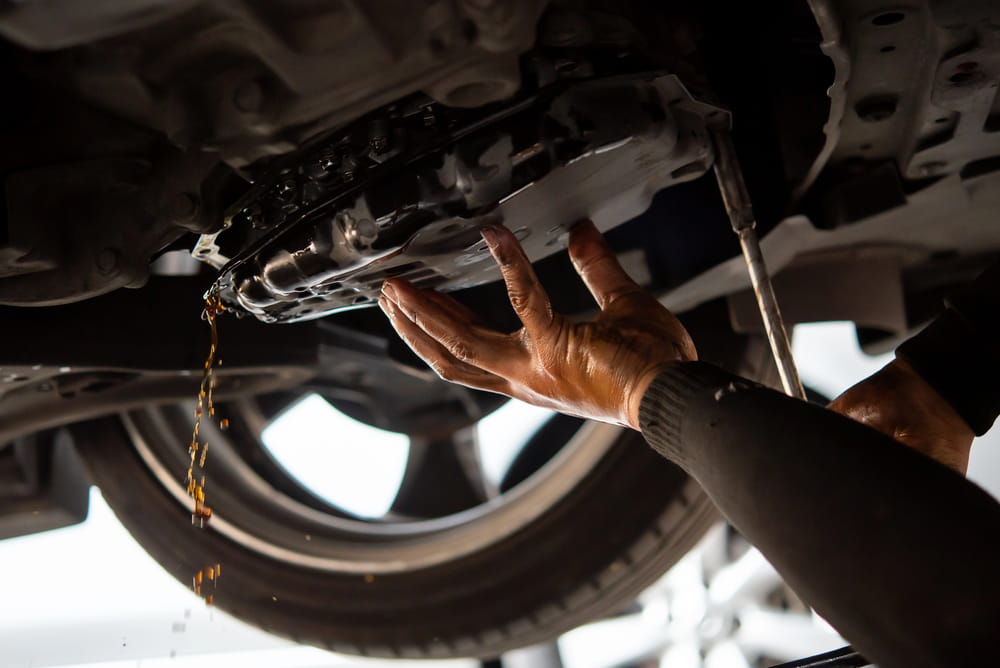
Most car owners are well aware of the fact that in order to keep the engine running properly, the engine oil must be changed regularly. However, surprisingly few give the same consideration to their transmission fluid. In fact, many people go years without servicing their transmission, only to discover the importance of transmission maintenance when they are faced with a hefty transmission repair bill.
Much like engine oil, transmission fluid serves several important purposes. It lubricates internal moving components, dissipates heat, reduces friction and in automatic transmissions, provides the hydraulic pressure necessary to operate various internal components. Over time, exposure to heat, friction and normal mechanical wear causes the fluid to deteriorate and accumulate contaminants, reducing its ability to allow for smooth shifts and protect the transmission from internal heat and friction-related damage.
The Problem With “Lifetime” Transmission Fluid
Do not blame yourself for thinking that your transmission fluid lasts for the life of the vehicle. Over the last decade or more, many vehicle manufacturers have started advertising their transmissions as being filled with “lifetime” fluid, suggesting that under normal driving conditions, the fluid never needs to be replaced. Unfortunately, that is not the case, as the term “lifetime” is used to essentially mislead the public. In reality, there is no such thing as lifetime fluids. The manufacturers essentially used the fine print to redefine the term “lifetime” to make the car appear as if it will cost less to own over a long period of time. Advertising a vehicle as requiring less maintenance makes it more appealing to prospective buyers.
What exactly constitutes the lifetime of a vehicle in the eyes of car companies? A manufacturer's definition of a vehicle's expected service life may be considerably different from that of someone who intends to keep their car for 15 or 20 years. Is it usually defined as 100,000 to 150,000 miles depending on the vehicle manufacturer and model?
The whole concept of lifetime transmission fluid feels more like a marketing scam, particularly for consumers who plan on keeping their vehicles long after the factory warranty expires. There is no transmission fluid on sale today that is immune to thermal degradation, contamination, or the effects of aging.
How Often Should Transmission Fluid Be Changed?
Just because a manufacturer does not specify a fluid replacement service interval, it does not mean the fluid will retain its original properties indefinitely. The real service intervals vary depending on the vehicle, transmission design and driving conditions and the following are reasonable general guidelines:
- Conventional automatic transmissions: Every 30,000 in hard stop and go driving to 60,000 of normal driving.
- Continuously variable transmissions (CVT): Every 30,000 in hard stop and go driving to 50,000 of mostly highway driving.
- Manual transmissions: Every 35,000 in hard stop and go driving to 60,000 of mostly highway driving.
- Dual-clutch transmissions (DCT): Every 30,000 in hard stop and go driving to 60,000 miles of highway driving, depending on the design.
Always consult the vehicle's specific service requirements and use the correct transmission fluid. Drivers who frequently tow trailers, drive in heavy stop-and-go traffic, live in hot climates, or regularly travel through mountainous terrain should pay particular attention to severe-duty maintenance intervals.
Why Transmission Fluid Changes Are Especially Important for vehicles with CVTs (Continuously Variable Transmission)
Continuously variable transmissions have become increasingly common in modern vehicles because of their ability to improve fuel economy and provide smooth acceleration without the jerky shifts commonly experienced in conventional automatic transmissions. However, many CVTs have also developed a reputation for premature failure. CVT problems have plagued a slew of makes and models across a wide range of automotive brands like Nissan, Subaru, Jeep, Ford, Mitsubishi and Honda.
Unlike a conventional automatic transmission, most automotive CVTs use a steel belt or chain operating between variable-diameter pulleys. The fluid must provide very specific friction characteristics, maintain hydraulic pressure, lubricate internal components and control operating temperatures while allowing a limited amount of slip between the belt and pulleys.
As the fluid deteriorates, it can contribute to excessive wear, overheating, shuddering, and other transmission problems. Neglecting fluid maintenance can significantly shorten the service life of an already sensitive transmission design. If you own a vehicle with a CVT, consider replacing the fluids more frequently. The alternative is far more expensive, as it can cause catastrophic damage to the transmission, easily costing several thousand dollars. Spending a few hundred dollars on periodic maintenance is a relatively small investment.
Transmission Fluid Change vs. Transmission Flush
There is also an important distinction between a traditional transmission fluid change and a transmission flush. A conventional drain-and-fill replaces a portion of the old fluid with fresh fluid, while a fluid exchange replaces most of the existing fluid.
For older, high-mileage vehicles with an unknown maintenance history, it is generally advisable to have the transmission inspected before performing a complete fluid exchange. There is a chance that doing a fluid change with a vehicle that has existing transmission damage or excessive wear from neglect or abuse may actually accelerate the failure. If the car never got an oil change in its lifetime and it has over 100,000 miles, it is best to have the transmission properly examined and fluid tested before performing a transmission service.
Avoid aggressive chemical flushes and always follow the appropriate service procedure, including replacing the transmission filter where applicable. At the end of the day, one of the best ways to extend the life of your vehicle is to stay ahead of its maintenance needs rather than waiting for something to break. Transmission fluid is no exception. Regardless of what the term “lifetime fluid” might suggest, regular transmission maintenance can go a long way toward preventing premature wear and avoiding costly repairs.
Read more articles
Post a comment
Popular Articles
How Often Should You Change Your Car’s Transmission Fluid?
Pros and Cons of Wheel Spacers: Are They Worth It?

California's New Tire Regulations Could Cost Drivers More Than They Bargained For

Why More and More Drivers are Saying No to the Bells and Whistles and Choosing Simpler, No-Frills Vehicles
The Hidden Truth About the Collision Repair Industry and Why a Shiny Paint Job Doesn't Always Mean a Properly Repaired Car